

Addressing the forum on ‘individualized approach’ on the sidelines of the Intersessional Meeting of the Anti-Personnel Mine Ban Convention today, Sri Lanka Permanent Representative Ambassador Azeez recounted how Sri Lanka achieved success in what was considered a perilous task in 2009.
Ambassador Azeez highlighted Sri Lanka’s engagement in demining activity as one which had its own complexity and uniqueness. The National Policy on Reconciliation and Co-existence, in place in Sri Lanka since 2017, both underpinned and nourished the ongoing programmes of peacebuilding and development in the country, he stressed.
The Sri Lanka delegation to the Intersessional Meeting that took place in Geneva from 7-8 June, was led by P. Suresh, Secretary to the Ministry of Resettlement, Rehabilitation, Northern Development and Hindu Religious Affairs and Director of the National Mine Action Centre. Delivering a national statement at the Intersessional Meeting, he thanked the partner countries and partner organizations for the assistance provided for Sri Lanka Mine Action Programme, which he stated was expected to be completed by 2020.
Statement delivered by Ambassador Azeez
Permanent Mission of Sri Lanka
Geneva
8 June 2018
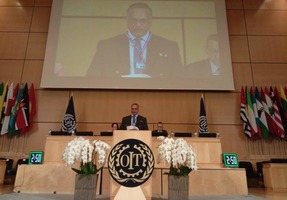
'Sustained, inclusive and sustainable growth' could hardly be realized without properly addressing the inequalities in the world of work', stated the Minister of Labour and Trade Union Relations Hon. Ravindra Samaraweera, today, 4th June 2018, speaking at the Plenary Meeting of the 107th Session of the International Labour Conference (ILC) being held in Geneva from 28 May - 9 June 2018.
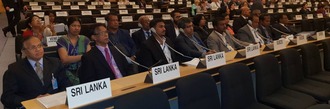
Highlighting some of the significant achievements made by Sri Lanka in the field of labour, Minister Samaraweera observed that being the first country in the world to implement a National Decent Work Plan on par with ILO principles, Sri Lanka has also given priority to 'labour rights', through its inclusion in the National Human Rights Action Plan 2017-2021. He added further that Sri Lanka is in the process of introducing a 'single employment law', consolidating disparate laws that currently exist, and giving effect to the principle of non-discrimination. Sri Lanka, the Minister stressed, has also made strides in progress toward eliminating child labour, and promoting the rights of the child, offering to share its expertise in this area to support the endeavours of the ILO.
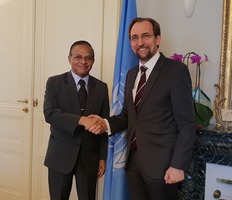
As part of a series of meetings that Ambassador A.L.A Azeez, Sri Lanka’s Permanent Representative, had with Heads of UN and other agencies in Geneva, he called on H.E. Zeid Ra'ad Al-Hussein, United Nations High Commissioner for Human Rights on 18 May 2018. Having warmly received Sri Lanka's Permanent Representative, High Commissioner Zeid Ra'ad Al-Hussein conveyed to Ambassador Azeez his best wishes for the new assignment while appreciating the Government of Sri Lanka for the continuing cooperative engagement with his Office and the Council.
Ambassador Azeez elaborated the various measures taken by the Government of Sri Lanka, especially since 2015, to improve and advance human rights, highlighting areas in which further work was continuing and progress was being made. High Commissioner shared his perspectives on matters of priority interest to both sides and specifically noted the positive contribution of technical assistance in areas on which Sri Lanka required capacity building and other forms of support.
Peacebuilding and reconciliation, protection and promotion of human rights, rule of law and other concerns including developments in the wider region were among the matters discussed.
Permanent Mission of Sri Lanka
Geneva
30 May 2018
Several delegations congratulated Dr. Rajitha Senaratne, Minister of Health, Nutrition, and Indigenous Medicine of Sri Lanka on being elected as a Vice-Chair of the Executive Board (EB) of the World Health Organization (WHO) for a term of one year during the 143rd session of the EB/WHO held in Geneva from 28-29 May 2018. Sri Lanka currently serves as a Member of the Executive Board, elected for a term of three years in May 2017.
Members of the South East Asia Region (SEAR) unanimously nominated Dr. Rajitha Senaratne to the post of Vice-Chair from SEAR.
Dr. Senaratne thanking the Executive Board on his election, emphasized the necessity of learning from the experiences of peers, while sharing Sri Lanka’s experiences with them towards achieving Universal Health Coverage, a goal agreed in the UN Development Agenda 2030.
During his participation of the 71st session of the World Health Assembly (WHA71) and the 143rd session of the Executive Board meeting (EB143) of the WHO, Sri Lanka received special compliments as a country which has taken progressive measures towards realization of SDG 3-Universal Health Coverage and launched bold initiatives on control of NCDs and access to affordable medicines.
Minister Senaratne had been invited to address the Panel Discussion – ‘Saving lives, Spending less: A Strategic Response to Non-Communicable Diseases (NCDs)’ jointly organized by the WHO and the WHO Goodwill Ambassador for NCDs Mr. Michael Bloomberg, on the sidelines of WHA71 in recognition of Sri Lanka’s achievements in the health care sector under his stewardship.
Permanent Mission of Sri Lanka
Geneva
30 May 2018
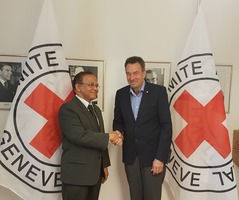
The Permanent Representative of Sri Lanka to the United Nations in Geneva met with President of the ICRC Mr. Peter Maurer at the ICRC Headquarters today. Referring to various measures taken by the Government of Sri Lanka to address humanitarian aspects involved in peacebuilding and reconciliation, Mr. Maurer noted the recent progress achieved in establishing and operationalizing the Office of Missing Persons (OMP).
Ambassador Azeez conveyed the appreciation of the Government of Sri Lanka for technical assistance provided by the ICRC particularly at the preparatory stages of work relating to draft policy and legal framework and structure of OMP.
Mr. Peter Maurer commended Sri Lanka for becoming a State party to the Anti-Personnel Mine Ban Convention (Ottawa Treaty) and the Convention on Cluster Munitions (Oslo Treaty), which he noted “sent a positive signal regarding the range of commitments that Sri Lanka has undertaken in humanitarian disarmament”.
Ambassador Azeez said Sri Lanka looked forward to further cooperation with the ICRC on technical expertise and capacity building in areas of shared priority.
Permanent Mission of Sri Lanka
Geneva
23 May 2018
“Developing strategies to meet the emerging and disruptive technologies so as to become competitive regionally and globally is an important priority for Sri Lanka”, stated the Minister of Science, Technology and Research, Skills Development and Vocational Training and Kandyan Heritage Dr. Sarath Amunugama, participating at the 21st Session of the Commission on Science and Technology for Development (CSTD) held in Geneva from 14-18 May 2018.
Addressing the high level round table on “impact of rapid technological change on the achievement of sustainable development goals”, the Minister elaborated the various challenges faced by developing countries, which hindered the positive impact of rapid technological changes in achieving sustainable development goals. He underlined the need for comprehensive studies on hazards as well as on the negative impact of new and emerging technologies on industries, and stressed the importance of leveraging technologies that had the potential for increased market share and competitiveness.
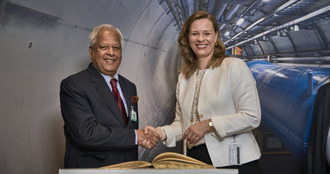
“The ongoing Sri Lanka-CERN cooperation could be further enhanced by involving other technical universities including in the engineering and information technology fields in the coming years”, said Minister of Science, Technology and Research, Skills Development and Vocational Training and Kandyan Heritage Dr. Sarath Amunugama at a discussion held with Ms. Charlotte Warakaulle, Director for International Relations, European Organization for Nuclear Research (CERN) in Geneva, during his visit to the CERN on 15 May 2018. Sri Lanka – CERN partnership has recorded considerable increase in the participation of doctoral candidates and physicists in critical particle physics experiments of CERN.
While commending CERN for enhanced cooperation with Sri Lanka during the past few years, the Minister emphasized the importance of the involvement of undergraduates, PhD candidates as well as scientists in CERN experiments. Ms. Warakaulle stated that such exposures would provide an important opportunity to bring back to Sri Lanka not only the much needed knowledge on particle physics but also useful insights in the latest advancements in high technology. Access to data generated in the experiments, would be extremely useful for universities to broaden their research capacities as well as for potential use in industries, she stressed.
It was agreed that collaboration would continue in the form of training for Sri Lankan physicists and students in CERN experiments as well as in various other CERN programmes such as the prestigious ‘Summer Student Programme’, paving the way for building the critical mass of scientific expertise in Sri Lanka in the field of high energy particle physics.
- Recent Decisions in the CD, a consolation to fill gaps in substantive work, says Ambassador Azeez
- Inter – agency cooperation vital to ensure labour migration benefits to Developing Countries. Sri Lanka’s Permanent Representative
- Sri Lanka a major player in Migration Health says Director General of IOM